Vertabelo Alternative: Luna Modeler, Desktop Data Modeling Without the Cloud
Luna Modeler is a Vertabelo alternative for teams that want their schemas on their own machines rather than on someone else's servers. It is a desktop application for Windows, macOS, and Linux, it works offline, and it is sold under a one-time perpetual license instead of a subscription.
Vertabelo is a browser-based data modeling tool. You open it in a browser, your schemas are stored on Vertabelo's servers, and you pay a recurring subscription to access them. For teams that prioritize browser-based collaboration and cloud storage, that model works.
For teams that prioritize data privacy, offline capability, or a one-time purchase rather than an ongoing subscription, it does not. This page explains why those teams choose Luna Modeler instead.
The core difference: where your schemas live
With Vertabelo, your database schemas are stored on a third-party server. You are trusting Vertabelo's infrastructure with the structure of your data — table names, field definitions, relationships, business logic encoded in your model. For many teams, especially those working in regulated industries or with sensitive data, this is not an acceptable arrangement regardless of what the privacy policy says.
Luna Modeler is a desktop application. Your schemas are stored as local files on your machine. They never leave your environment unless you explicitly export or share them. There is no server in the path, no cloud account, and no third party with access to your model.
This is not a privacy setting — it is the architecture. The full technical details are documented here.
Subscription vs. perpetual license
Vertabelo requires a subscription. When you stop paying... Luna Modeler is sold under a perpetual license — you pay once. Your models are local files that belong to you, not to a cloud service.
Optional annual updates are available if you want new features, but they are genuinely optional. The version you purchased continues to work regardless of whether you renew. There is no scenario where your access to your own data models is contingent on maintaining a subscription with a vendor.
What this Vertabelo alternative offers
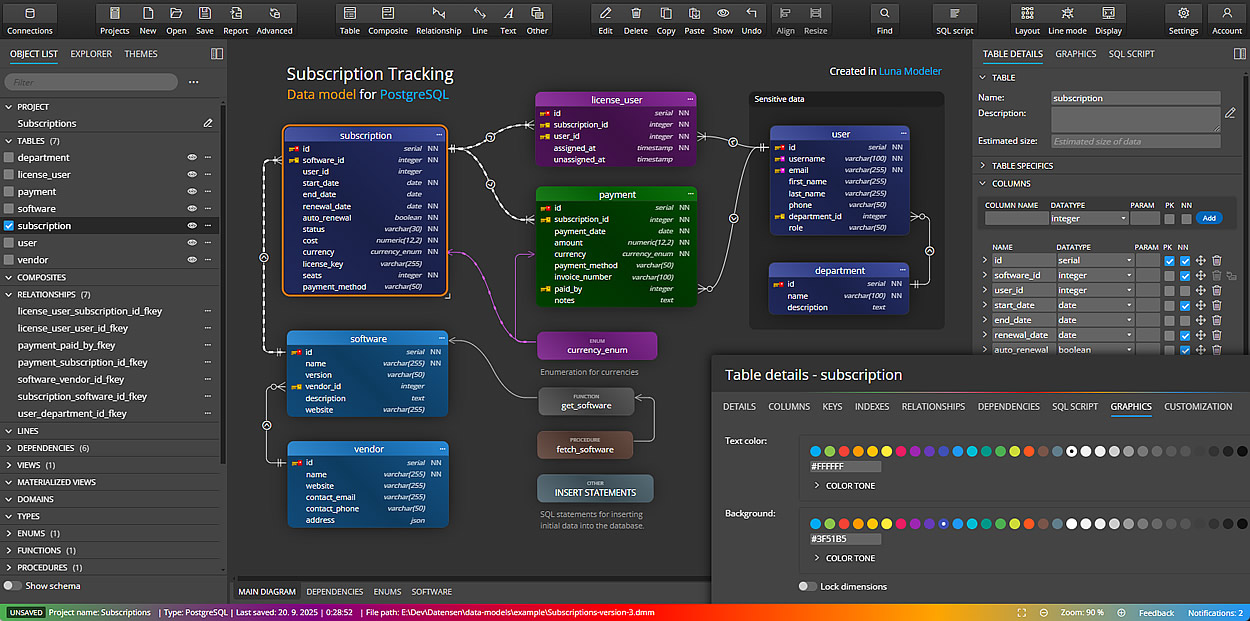
- Visual ER diagram creation for Oracle, PostgreSQL, SQL Server, MySQL, MariaDB, and SQLite
- Forward engineering with platform-specific SQL DDL
- Reverse engineering from live databases
- ALTER script generation for schema synchronization
- Schema conversion between database platforms
- Interactive HTML documentation reports
- Works fully offline — no internet connection required for core functionality
- Runs on Windows, macOS, and Linux
- Folder-based project format for real Git-based team collaboration, with reviewable diffs and pull requests
- Headless CLI for reverse engineering, schema drift detection, and CI/CD automation
Real version control instead of a shared browser tab
Vertabelo's collaboration model is a shared cloud workspace — everyone edits the same hosted diagram. That's fine for keeping a team looking at the same thing, but is it version control? Does it offer per-object diff, pull requests, a way to see exactly what a teammate changed, when and why?
Luna Modeler's Ultimate Edition takes a different approach: a folder-based format that saves the model as small, human-readable YAML/JSON files — one per table, column, and relationship. Commit that folder to Git, and every change becomes a real, reviewable diff. Schema changes go through normal pull requests, and merge conflicts stay scoped to the one object that actually changed.
The headless CLI adds automation Vertabelo's browser-only architecture can't offer: reverse-engineer a database, detect schema drift against the model, and regenerate SQL, documentation, and diagrams from a terminal or CI/CD pipeline — enterprise-grade release checks, at a fraction of a recurring subscription's cost.
Is Luna Modeler the right Vertabelo alternative for you?
Vertabelo is a well-designed browser tool and makes sense for teams whose workflow is browser-first and who are comfortable with cloud storage of their schemas. Luna Modeler does not try to replicate that browser-based collaboration model — it replaces it with Git-based version control instead.
What Luna Modeler does: gives you a professional, fully capable data modeling tool that runs on your machine, stores your data locally, collaborates through Git, automates checks through its CLI, requires no subscription, and works without an internet connection. If any of those properties matter to you or your organization, Luna Modeler is the more appropriate tool.
Try Luna Modeler free for 14 days
What is the best offline Vertabelo alternative?
Luna Modeler is a desktop application for Windows, macOS, and Linux, so the full modeling workflow — ER diagrams, platform-specific SQL generation, reverse engineering, ALTER scripts, documentation — runs without a network connection, and your schemas stay as local files on your own machine.
Is there a free Vertabelo alternative?
Free and open-source ER diagram tools exist, but most support a single database engine and stop short of ALTER script generation and documentation output. Luna Modeler is sold under a one-time perpetual license rather than a subscription, with a 14-day free trial that carries no feature restrictions.
Can I use Luna Modeler without an internet connection?
Yes. Core modeling functionality works fully offline. License activation requires a one-time internet connection. After that, the tool operates without network access.
What happens to my models if I stop renewing the Luna Modeler update subscription?
Nothing. Your license is perpetual — the software continues to work and your project files remain accessible. Update renewals are optional. You never lose access to your models.
Are my schemas stored on Datensen's servers?
No. Your project files are stored on your local filesystem. Nothing is uploaded to Datensen or any third party. Full privacy details here.
Can I share models with my team?
Yes. Project files are plain .dmm files, or a folder-based format built for Git. Share them via Git, a network share, or any file-transfer method your team already uses.
How does Luna Modeler's collaboration compare to Vertabelo's shared workspace?
Vertabelo gives you a shared cloud workspace. Luna Modeler's folder-based format gives you real version control instead — per-object diffs, pull requests, and merge conflicts scoped to the object that changed — through Git, with no subscription required.
Does Luna Modeler support NoSQL databases?
Luna Modeler is built for relational databases. For MongoDB and other NoSQL databases, try Moon Modeler.
Comparing other data modeling tools?
Luna Modeler is evaluated as a replacement for most established data modeling tools. These pages cover the rest:
- Luna Modeler as a Toad Data Modeler alternative
- Luna Modeler as an erwin Data Modeler alternative
- Luna Modeler as an ER/Studio alternative
- Luna Modeler as a SAP PowerDesigner alternative
- Luna Modeler as a dbdiagram.io alternative
Disclaimer: Ideamerit s.r.o. is not affiliated with, endorsed by, or sponsored by Vertabelo. The mention of Vertabelo is for comparison and informational purposes only.