Why Moon Modeler
The thinking behind Moon Modeler
Some tools assume your schemas belong in the cloud. Some assume a subscription is the natural order of things. Moon Modeler was built on different assumptions. Here they are.
Local-first, because your schemas deserve it
Online schema tools store your models on someone else's server. Moon Modeler doesn't.
- Native desktop app — no browser, no account.
- Works offline for day-to-day work.
- Schemas open instantly from local files.
- Nothing leaves your machine unless you share it.
Under GDPR or internal data governance, "where is the schema stored?" has one answer: on your machine. Security through architecture beats security through policy.
Designed for documents, not retrofitted for them
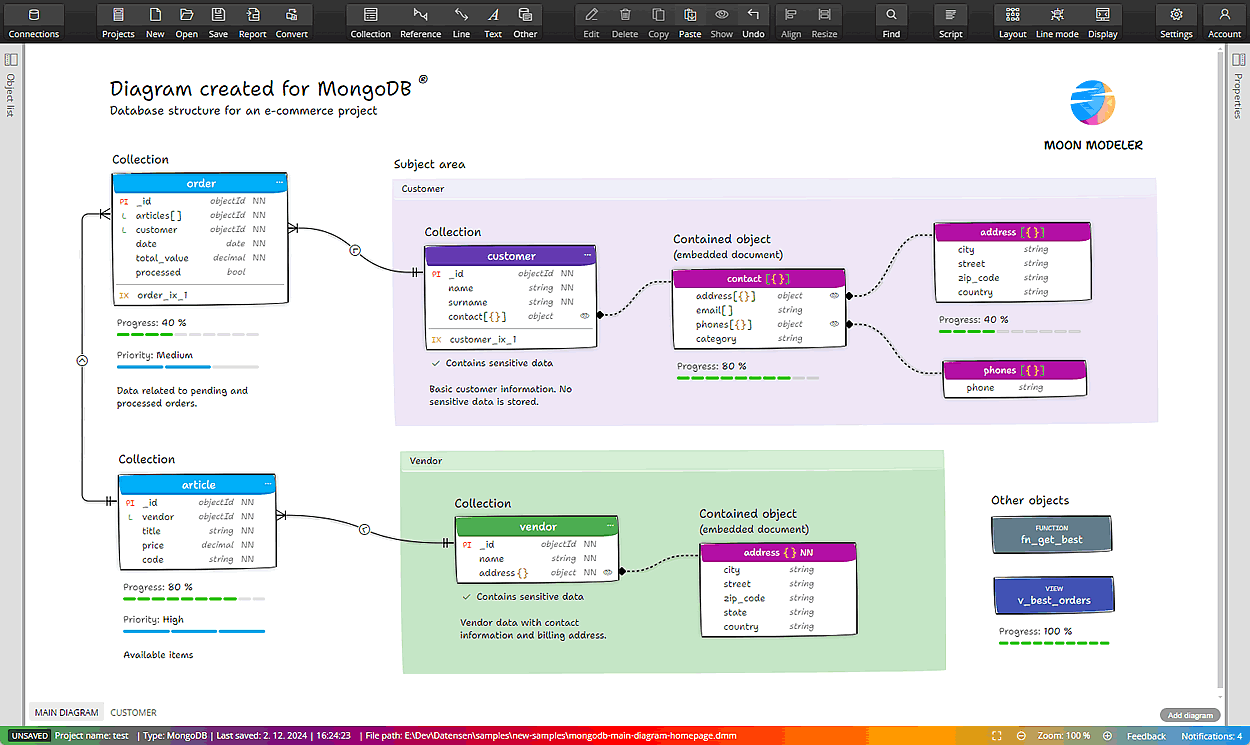
Many tools treat MongoDB as a checkbox feature — a relational metaphor forced onto collections. Moon Modeler was built for documents from day one:
- Embedded documents as a first-class construct, not a workaround.
- Nested structures and polymorphic arrays.
- JSON Schema validators ready to attach to a collection.
- Mongoose model definitions you can drop into your codebase.
Supported platforms: MongoDB, Mongoose ODM, Amazon DocumentDB, and Azure Cosmos DB (MongoDB API).
Lifetime licensing, not just access to the tool
Moon Modeler uses a perpetual license. You pay once.
- No auto-renewing contract.
- No surprise price increase at next year's invoice.
- No vendor decision can lock you out of your own schema files.
- Optional update renewals if you want new features — your version keeps working either way.
Schema work compounds. What you build in Month 1 is still valuable in Year 3 — and it belongs to you.
No account. No telemetry. No surprises.
Moon Modeler asks for one thing: a license key at activation. That's the complete picture.
- No account to create.
- No usage data collected.
- No background uploads of your work.
- Connection credentials — including MongoDB Atlas, SSL certificates, SSH keys — encrypted and stored in a local keystore. They never pass through Datensen infrastructure.
For regulated data, this removes a whole class of compliance questions: no third-party data processor, no DPA to negotiate, no cloud audit trail.
Twenty years in database tooling, and counting
- Built by Ideamerit s.r.o., a Czech software company with two decades in database modeling tools.
- Not a pivot or a side project — modeling tools are the entire business.
- Multi-year release history and an active development team.
- Users in more than 85 countries.
- The same team builds Luna Modeler for Oracle, PostgreSQL, SQL Server, MySQL, MariaDB, and SQLite.
A schema tool becomes part of your team's knowledge base. Pick one with a track record.
Schema diagrams that explain themselves
A collection diagram shows structure. It rarely explains why. Moon Modeler lets you answer that inside the model itself:
- Notes explaining embed-vs-reference decisions and validation rules.
- Graphics and visual elements for context.
- Flowchart, use case, and data flow components — in the same project file.
Developers, product managers, and new hires get a model that explains intent, not just structure. Diagrams with context travel better across teams.
The thinking cannot be skipped
AI can produce a MongoDB schema in seconds. Some of it will work. Some will be plausible but wrong — embedded where references belong, validation missing, array types that don't match real documents. You find out when data starts flowing.
Document design is a design problem, not a text generation problem. Embed or reference? Which access patterns matter? How does the schema evolve without breaking data? Those answers need domain knowledge no prompt can supply.
Moon Modeler assumes you do the design work. It provides the structure, validation, code generation, and documentation. The decisions stay yours.
Who Moon Modeler is for
Moon Modeler is a strong fit when one or more of the following apply:
- You work with MongoDB, Mongoose ODM, Amazon DocumentDB, or Azure Cosmos DB and need runnable output — not pseudocode.
- You want schema files stored locally, with no cloud platform in the middle.
- You prefer a one-time purchase over a subscription.
- JSON Schema validators or Mongoose models are deliverables in your workflow.
- Compliance rules make third-party cloud storage of schema data a problem.
- You want HTML documentation and PDF exports that live outside any vendor platform.
Is Moon Modeler a cloud or SaaS product?
No. It is a native desktop application. Your schemas, diagrams, and connection credentials are stored on your local machine. Nothing is uploaded to any server unless you explicitly export or share a file.
Do I pay a recurring subscription for Moon Modeler?
No. Moon Modeler uses a perpetual license model. Optional annual update renewals are available if you want new features, but they are not required to keep the software running.
Does Moon Modeler generate real code or generic output?
Real code. Moon Modeler generates MongoDB JSON Schema validators you can apply directly to a collection, and Mongoose model definitions you can drop into a project. The output reflects the actual syntax and conventions of the target platform.
Can I use Moon Modeler on Windows, macOS, and Linux?
Yes. Moon Modeler is a native desktop application that runs on all three platforms. There is no browser involved and no operating system limitation.
Can Moon Modeler connect to MongoDB Atlas or cloud-hosted MongoDB?
Yes. Moon Modeler connects directly to MongoDB Atlas, Amazon DocumentDB, and Azure Cosmos DB via SSL/TLS. All credentials are encrypted and stored locally — they are never relayed through Datensen servers.
Can I add notes, diagrams, and visuals to my schema model?
Yes. Beyond collection diagrams, you can include notes, graphics, and diagram elements — flowchart, use case, and data flow components — directly in the same project file. This makes the model useful for people who do not read schema syntax.
Should I use AI to generate my MongoDB schema instead?
AI can produce a starting point, but document database design requires decisions — embed vs. reference, access pattern optimization, validation rule design — that depend on domain knowledge a model cannot infer from a prompt. Moon Modeler is the environment where you make and document those decisions properly.