Why Luna Modeler
Why Developers Choose Luna Modeler
Choosing a data modeling tool means choosing how you work. Luna Modeler makes a few deliberate choices. Here is what they are — and why they matter.
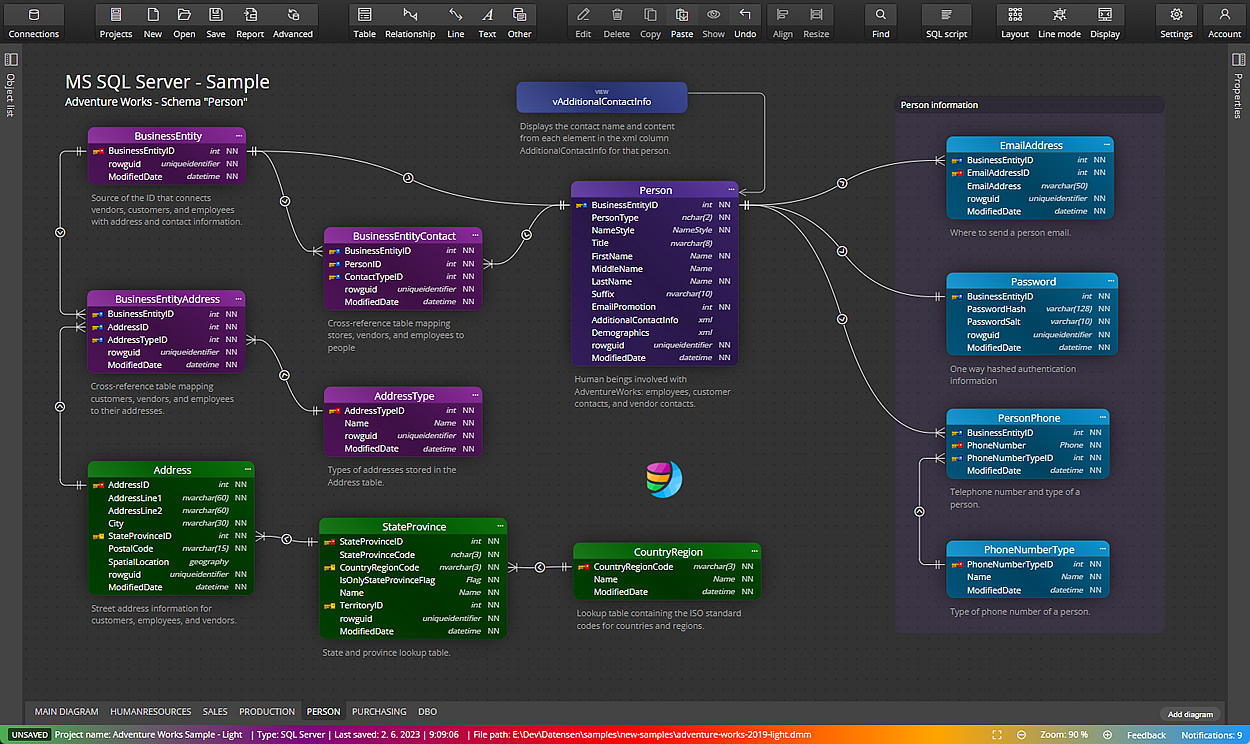
Desktop-native by design, not by accident
Most tools moved to the browser. Luna Modeler went the other way — on purpose.
- Opens instantly. No login screen, no loading spinner.
- Works fully offline. No internet connection required.
- Connects to your database directly from your machine.
- Schemas, credentials, and business logic never pass through a third-party cloud.
That removes an entire category of risk that SaaS tools introduce by default.
Perpetual license — pay once, own it
Luna Modeler is sold under a perpetual license. You pay once.
- No subscription that expires mid-project.
- No price changes or tier shuffles next quarter.
- No seat portals, no usage-based billing, no recurring budget line.
You buy. You install. That's it.
Privacy-first — by architecture, not by policy
- No account required.
- No telemetry collected.
- No project files uploaded — ever.
A tool that never receives your data cannot leak it, sell it, or expose it in a breach. That is not a privacy policy you have to trust. It is how the software is built.
Modeling personal data, payments, or health records? Under GDPR or other regulation? Your story stays simple: the data never leaves your machine.
Platform-specific SQL — because generic SQL is not enough
Every database speaks its own dialect. Generic DDL needs manual cleanup before it runs. Luna Modeler generates SQL you can execute as-is:
- Native data types, indexes, and constraints per platform.
- PostgreSQL domains, composite types, and schemas.
- Oracle packages, tablespaces, and sequences.
- SQL Server user-defined types and filegroups.
Supported platforms: PostgreSQL, Oracle, SQL Server, MySQL, MariaDB, and SQLite.
Built by a team with decades of database experience
- Developed by Ideamerit s.r.o., a Czech software company with 20+ years in data modeling tooling.
- Multiple major versions, updated platform support, active documentation.
- Users in more than 85 countries.
- The same team builds Moon Modeler for MongoDB and NoSQL — modeling is the core business, not a side project.
Your schemas and diagrams accumulate value over time. They deserve a tool with a track record.
A data model is more than an ER diagram
ER diagrams show structure. Real communication needs context. Luna Modeler lets you add both — directly alongside your schema objects:
- Notes that explain naming decisions and business rules.
- Graphics and visual elements for context.
- Flowchart, use case, and data flow diagram components.
Stakeholders may never read a DDL script. They can follow a well-annotated diagram. A model that explains itself is simply more useful.
Data models created by humans, not generated by AI
AI can draft a schema from a prompt. Some of it will be reasonable. Some will be confidently wrong — and you won't notice until production.
Modeling is a design activity. Deciding what entities exist, how they relate, and what constraints apply requires domain understanding. Skipping that thinking is not a shortcut — it is debt: integrity issues, migration pain, undocumented decisions.
Luna Modeler gives you the canvas, the constraints, and the forward engineering. The design decisions stay yours.
Who Luna Modeler is for
Luna Modeler fits best when some of the following are true:
- You work with Oracle, PostgreSQL, SQL Server, MySQL, MariaDB, or SQLite and need executable DDL.
- You prefer tools that run on your machine — no cloud, no mandatory accounts.
- You want a perpetual license, not a subscription.
- You need forward engineering, reverse engineering, or ALTER scripts in your workflow.
- Schema data leaving your machine is a compliance concern.
- You want HTML reports and PDF diagrams you control — no third-party viewer.
Is Luna Modeler a cloud or SaaS product?
No. Luna Modeler is a desktop application that runs entirely on your machine. No account required, no data sent to any server. Your schemas and diagrams stay on your computer.
Do I pay a recurring subscription for Luna Modeler?
No. Luna Modeler is sold under a perpetual license. You pay once.
Does Luna Modeler generate real SQL or generic output?
Luna Modeler generates platform-specific SQL tailored to the syntax and features of your target database — Oracle, PostgreSQL, SQL Server, MySQL, MariaDB, or SQLite. This includes platform-specific data types, indexes, constraints, and constructs like PostgreSQL domains or Oracle packages.
Can I use Luna Modeler on Windows, macOS, and Linux?
Yes. Luna Modeler is cross-platform and runs natively on Windows, macOS, and Linux. There is no browser dependency.
Is Luna Modeler right for teams, or just individuals?
Both. Project files are plain files that live on disk — you can check them into Git, share via a file server, or review diffs like any other text artifact. Each team member holds their own license.
Can I add notes, diagrams, and visuals to my data model?
Yes. Luna Modeler lets you enrich your model with notes, graphics, and diagram elements including flowchart, use case, and data flow diagram components. A data model that explains its own context communicates more clearly than one that only describes tables.
Should I use AI to generate my data model instead?
AI tools can suggest structures, but the act of modeling — deciding what entities exist, how they relate, what constraints apply — is a design activity that requires domain understanding. Luna Modeler supports that thinking process. The design decisions stay with you.