When you look at a standard Entity-Relationship Diagram (ERD), you see the skeleton of your database: tables linked by primary and foreign keys. But any experienced DBA knows that the skeleton isn’t the whole story.
Beneath the surface lies a complex web of dependencies. A change to a single table column can ripple through views, trigger errors in stored procedures, and break functions you forgot even existed. If you are conducting a database audit or planning a migration, “seeing” these hidden connections isn’t just a luxury – it’s a necessity for risk management.
In this post, we explore how Luna Modeler allows you to visualize the “hidden information” in your data models through its powerful Dependency features.
Why Relationships Aren’t Enough
Traditional ERDs focus on relationships – the links that enforce data integrity (like a CustomerID in an Orders table). However, dependencies are often functional.
For example:
- A View depends on the underlying tables it selects from.
- A Stored Procedure depends on the specific schema of the tables it updates.
- A Trigger depends on the existence of the table it monitors.
In a standard audit, these are often buried in lines of SQL code. Without visualization, identifying the impact of a schema change becomes a manual, error-prone task of “find and replace.”
Visualizing the Invisible with Luna Modeler
Luna Modeler takes database visualization beyond the basic table-link structure. It provides a specialized toolkit to uncover and document these hidden threads.
1. Automated “Infer Dependencies”
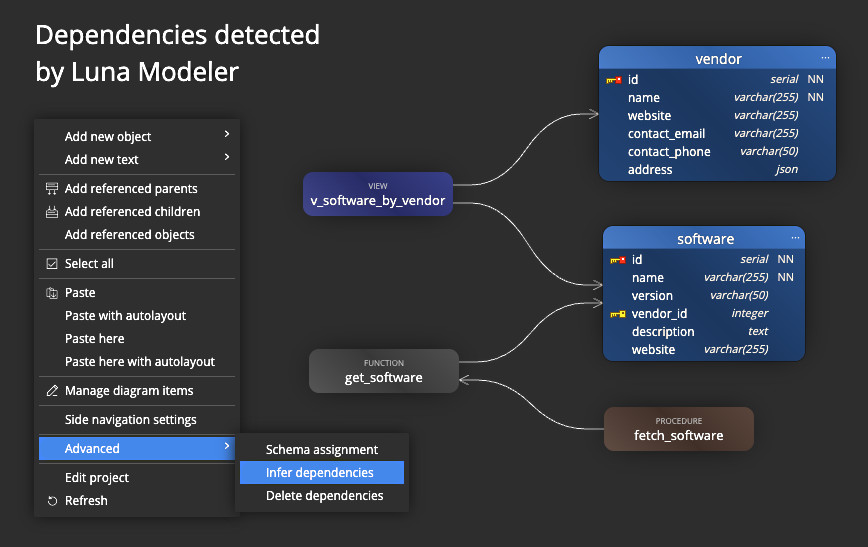
One of the most powerful tools for an auditor is the Infer Dependencies engine. Instead of manually drawing lines, you can ask Luna Modeler to scan the SQL code of your views, functions, and procedures.
- How it works: The tool parses the script, identifies object names, and automatically draws dependency lines to the source objects.
- The Benefit: You instantly see which views will break if you rename a column, providing a clear “impact map” for your audit report.
2. Manual Mapping for Edge Cases
Not every dependency is written in code. Sometimes, a dependency is conceptual or exists at the application level. Luna Modeler allows you to manually draw dependency lines between any objects – including notes, text blocks, or PostgreSQL Enums – ensuring your documentation reflects the real-world usage of the data, not just the technical schema.
3. Dedicated Dependency Layouts
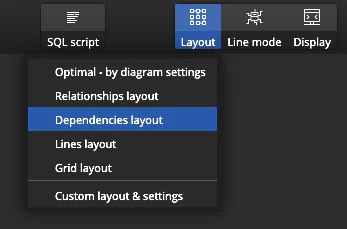
As a model grows, the “spaghetti” of lines can become overwhelming. Luna Modeler solves this with a dedicated Dependencies Layout. This mode re-arranges the diagram to prioritize functional dependencies over standard relationships. It clusters dependent objects together, making it easy to identify “hot spots”.
Bringing Transparency to Stakeholders
An audit is only as good as its reporting. Luna Modeler’s Interactive HTML reports include a dedicated section for dependencies.
When you hand over an audit to a client or a development team, they don’t just get a static image. They get a searchable, clickable report where they can select a table and immediately see every object that depends on it. This level of transparency transforms a database from a “black box” into a clear, navigable map.
Conclusion: Audit with Confidence
Understanding a database requires more than seeing how data is stored; it requires seeing how it is used. By visualizing object dependencies, Luna Modeler helps you uncover hidden risks and produce professional-grade documentation that stands up to the scrutiny of any audit.
Ready to see the hidden side of your data?
Download Luna Modeler and try the “Infer Dependencies” feature on your complex schema today.
 Luna Modeler
 Moon Modeler
 Galaxy Modeler
 Merit Modeler
 Meteor Modeler